Cloud vs. Decentralized Data: Digital Asset Management 2026

Anúncios
From Cloud Storage to Decentralized Data: Understanding Your Options for Digital Asset Management in 2026
In the rapidly evolving digital landscape, how we store, manage, and secure our invaluable digital assets is undergoing a profound transformation. As we look ahead to 2026, the traditional reign of centralized cloud storage is being challenged by the burgeoning power of decentralized data management. This shift isn’t just about where your files live; it’s about control, security, privacy, and the very architecture of the internet. For individuals and businesses alike, understanding these diverse options is no longer optional – it’s critical for navigating the future of digital asset management.
Anúncios
The sheer volume of data being generated globally is staggering. From personal photos and videos to critical business documents, intellectual property, and even entire digital identities, our lives are increasingly intertwined with digital information. The choices we make today about data storage and management will have significant implications for accessibility, resilience, and cost-effectiveness in the years to come. This comprehensive guide will delve deep into the nuances of both cloud storage and decentralized data solutions, equipping you with the knowledge to make informed decisions for your digital assets in 2026 and beyond.
The Dominance of Cloud Storage: A Familiar Landscape
For the past decade, cloud storage has been the undisputed champion of digital asset management. Services like Google Drive, Dropbox, Amazon S3, and Microsoft Azure have revolutionized how we store and share data. Their appeal is undeniable: convenience, scalability, and relatively low entry barriers. Users can access their files from anywhere, on any device, with automatic backups and synchronization. Businesses leverage cloud infrastructure for everything from website hosting to complex data analytics, enjoying the flexibility to scale resources up or down as needed without significant upfront hardware investments.
Benefits of Centralized Cloud Storage
- Accessibility: Data is accessible globally, 24/7, from any internet-connected device. This unparalleled accessibility has fueled remote work and global collaboration.
- Scalability: Cloud providers offer elastic storage, allowing users and businesses to easily scale their storage capacity up or down based on demand, paying only for what they use.
- Cost-Effectiveness: For many, especially small to medium-sized businesses, cloud storage eliminates the need for expensive on-premise hardware, maintenance, and IT staff.
- Ease of Use: User-friendly interfaces and robust integration with existing software ecosystems make cloud storage incredibly intuitive for most users.
- Managed Infrastructure: Cloud providers handle all the underlying infrastructure, security updates, and maintenance, freeing users from these operational burdens.
Challenges and Concerns with Cloud Storage
Despite its widespread adoption, cloud storage is not without its drawbacks, and these concerns are increasingly driving the search for alternative solutions, particularly in the realm of decentralized data management.
Anúncios
- Centralization and Single Points of Failure: Relying on a single provider means that an outage or failure at their data centers can render your data inaccessible. While rare, such incidents can have catastrophic consequences.
- Data Security and Privacy: Entrusting your data to a third party inherently creates security risks. While cloud providers invest heavily in security, they remain attractive targets for cyberattacks. Furthermore, privacy concerns arise from the fact that providers often have access to user data, subject to their terms of service and governmental regulations.
- Vendor Lock-in: Migrating large volumes of data from one cloud provider to another can be complex, time-consuming, and costly, leading to vendor lock-in.
- Lack of Control: Users typically have limited control over where their data is physically stored or how it’s managed beyond the provided interfaces.
- Censorship and Data Manipulation: Centralized entities can, under certain circumstances, be compelled to remove or restrict access to data, raising concerns about censorship and data integrity.
The Rise of Decentralized Data Management: A New Paradigm
Enter decentralized data management – a revolutionary approach that seeks to address the inherent vulnerabilities and limitations of centralized systems. Inspired by blockchain technology and peer-to-peer networks, decentralized storage distributes data across a vast network of independent nodes rather than storing it on a few centralized servers. This fundamental architectural difference underpins a paradigm shift in how we think about data ownership, security, and resilience.
How Decentralized Data Storage Works
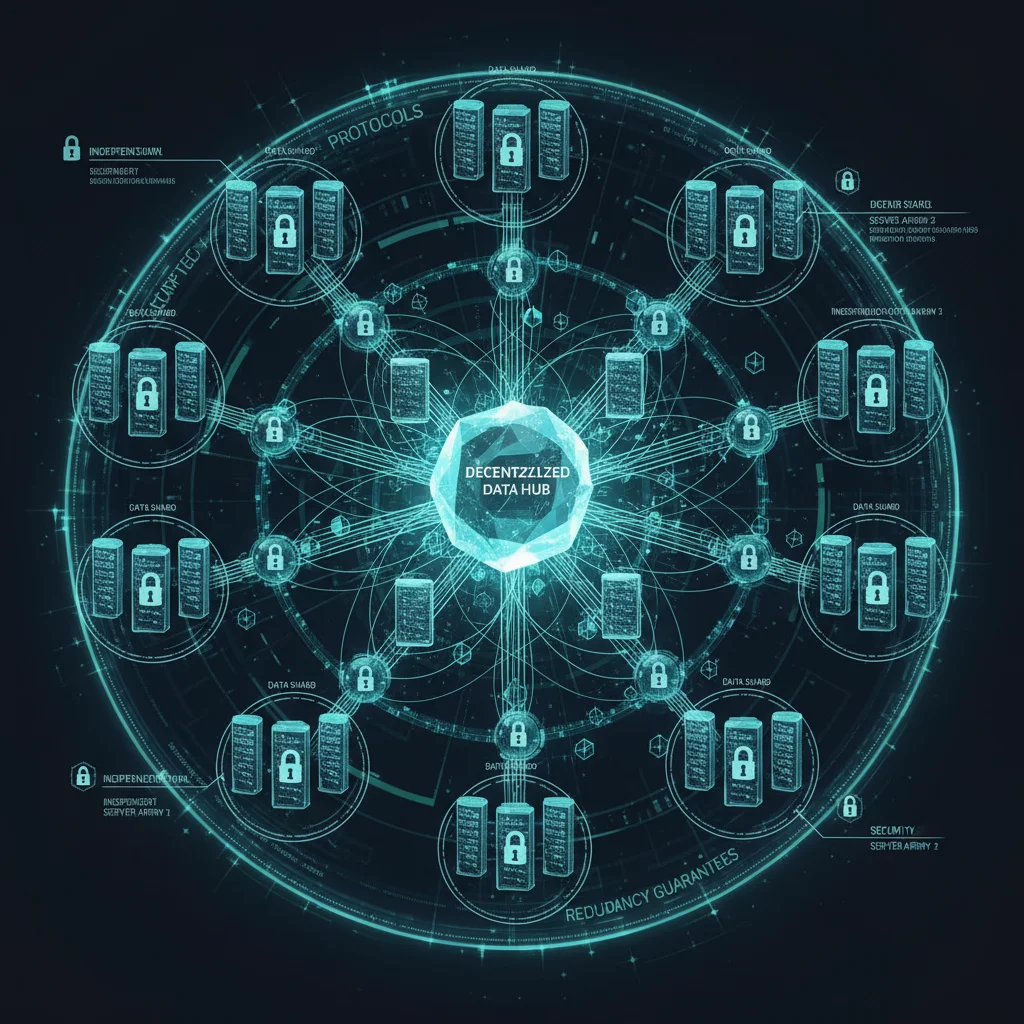
At its core, decentralized data storage involves breaking down data into smaller, encrypted chunks (shards) and distributing these shards across numerous independent storage nodes globally. These nodes are often operated by different individuals or entities, creating a highly distributed and resilient network. When a user requests their data, the system reassembles the shards, decrypts them, and presents the complete file. Key technologies enabling this include:
- Blockchain: Used for managing metadata, ensuring data integrity, and recording transactions (e.g., payments for storage).
- Peer-to-Peer (P2P) Networks: Facilitate direct communication and data transfer between nodes without a central server.
- Encryption: Data is encrypted before being broken into shards and distributed, ensuring privacy and security even if individual nodes are compromised.
- Redundancy: Multiple copies of data shards are stored across different nodes, guaranteeing availability even if some nodes go offline.
Key Benefits of Decentralized Data Management
The advantages of adopting a decentralized data management strategy are compelling, particularly as we move towards a more privacy-conscious and resilient digital future.
- Enhanced Security: By distributing encrypted data across many nodes, there’s no single point of attack for hackers. Even if a few nodes are compromised, the data remains secure and inaccessible without the complete set of encrypted shards and the decryption key.
- Increased Privacy: Users retain full control over their encryption keys, meaning only they can access their data. This drastically reduces the risk of unauthorized access by storage providers or third parties.
- Greater Resilience and Availability: The distributed nature ensures that data remains available even if a significant portion of the network goes offline. Redundancy built into the system means data can be reconstructed from remaining shards.
- Censorship Resistance: Without a central authority to control or remove data, decentralized storage is inherently more resistant to censorship and manipulation.
- Reduced Vendor Lock-in: The open and interoperable nature of many decentralized protocols makes it easier to migrate data and switch between services.
- Potential for Cost Savings: By leveraging a global network of independent storage providers, the cost of storage can potentially be lower than traditional cloud services, driven by market dynamics rather than monopolistic pricing.
- True Data Ownership: Users truly own and control their data, rather than merely renting storage space from a third party.
Challenges and Considerations for Decentralized Data Management
While promising, decentralized data management is still a nascent field with its own set of challenges that need to be addressed for widespread adoption.
- Complexity: The underlying technology can be more complex than traditional cloud storage, potentially posing a learning curve for new users and developers.
- Maturity and Adoption: The ecosystem is still developing, with fewer established providers and tools compared to the mature cloud industry.
- Performance: Data retrieval times can sometimes be slower due to the distributed nature and the need to reassemble shards from various locations. However, ongoing innovations are rapidly improving performance.
- Scalability Concerns (Initial): Early decentralized solutions faced scalability hurdles, but modern protocols are designed to handle vast amounts of data and increasing user bases.
- Regulatory Uncertainty: The decentralized nature of these systems can create challenges regarding data sovereignty and compliance with varying international data regulations.
- User Experience: For widespread adoption, decentralized solutions need to match or exceed the user-friendliness of current cloud offerings.
Key Players in the Decentralized Data Landscape (2026 Outlook)
As we approach 2026, several projects and platforms are leading the charge in decentralized data management. Understanding these key players can help you identify potential partners for your digital asset needs:
- Filecoin (FIL): Built on IPFS (InterPlanetary File System), Filecoin is a decentralized storage network that allows users to rent out their unused storage space. It aims to create a robust and censorship-resistant global data repository.
- Arweave (AR): Arweave focuses on ‘permaweb’ – permanent, decentralized storage for data that needs to last forever. Users pay a one-time fee to store data permanently, making it ideal for archiving and historical records.
- Siacoin (SC): Sia is another blockchain-based decentralized storage platform that connects users who need storage with hosts who have spare hard drive space. It emphasizes privacy and affordability.
- Storj (STORJ): Storj offers decentralized cloud storage that is S3-compatible, making it easier for developers to integrate with existing applications. It focuses on enterprise-grade security and performance.
- IPFS (InterPlanetary File System): While not a storage solution on its own, IPFS is a protocol for storing and accessing content in a distributed file system. Many decentralized storage solutions leverage IPFS as their underlying technology.
These platforms, among others, are continuously innovating, addressing the challenges, and building a more robust and accessible infrastructure for decentralized data management.
Choosing Your Digital Asset Management Strategy for 2026
The choice between centralized cloud storage and decentralized data management isn’t necessarily an ‘either/or’ proposition. For many, a hybrid approach might be the most effective solution in 2026. The optimal strategy will depend heavily on your specific needs, risk tolerance, and the nature of the digital assets you wish to manage.
Factors to Consider:
- Type of Data: Sensitive personal information, critical business records, or intellectual property might benefit most from the enhanced privacy and security of decentralized solutions. Less sensitive or frequently accessed data might be suitable for traditional cloud.
- Security and Privacy Requirements: If maximum security, data sovereignty, and resistance to censorship are paramount, decentralized options are increasingly attractive.
- Performance Needs: For applications requiring ultra-low latency and very high throughput, traditional cloud providers with globally distributed data centers might still hold an edge, though decentralized solutions are rapidly catching up.
- Cost: Evaluate the long-term costs. While decentralized storage can be cost-effective, pricing models vary, and some solutions might require cryptocurrency for payment.
- Ease of Use and Integration: Consider the technical expertise of your team or yourself. Cloud services generally offer a more polished and familiar user experience. Decentralized solutions are improving rapidly but may still require a steeper learning curve for some.
- Regulatory Compliance: Understand the regulatory landscape for your industry and geographical location. Ensure your chosen solution helps you meet compliance requirements.
- Future-Proofing: Decentralized data management offers a more resilient, open, and potentially future-proof infrastructure, aligning with the principles of Web3.

The Hybrid Approach: Best of Both Worlds?
For many organizations and individuals, a hybrid model offers a balanced approach to digital asset management. This could involve:
- Cloud for Active Data, Decentralized for Archival/Sensitive Data: Using established cloud providers for frequently accessed operational data and leveraging decentralized solutions for long-term archives, immutable records, or highly sensitive information.
- Decentralized as a Backup Layer: Employing a decentralized network as an additional, highly secure, and redundant backup for critical cloud-stored data, adding an extra layer of resilience against outages or data loss.
- Content Delivery Networks (CDNs) with Decentralized Backends: Using traditional CDNs for fast content delivery while storing the source content on a decentralized network for enhanced security and censorship resistance.
The flexibility of both systems allows for strategic deployment based on the specific needs of each digital asset, optimizing for performance, cost, security, and privacy.
The Future of Digital Asset Management Beyond 2026
Looking beyond 2026, the trajectory for decentralized data management is one of continued growth and integration. We can anticipate:
- Improved User Experience: As the technology matures, decentralized solutions will become even more user-friendly, abstracting away much of the underlying complexity.
- Greater Interoperability: Seamless integration between different decentralized protocols and with traditional Web2 applications will become more common.
- Enhanced Performance: Ongoing research and development will lead to faster data retrieval and processing speeds, making decentralized options competitive for even high-performance applications.
- Wider Adoption: As enterprises and governments recognize the benefits of security, privacy, and resilience, we will see broader adoption of decentralized technologies.
- New Business Models: The decentralized nature will foster innovative business models around data ownership, sharing, and monetization.
The journey from centralized cloud storage to a future dominated by decentralized data management is well underway. While cloud storage will continue to serve vital roles, the increasing demand for data sovereignty, enhanced security, and censorship resistance positions decentralized solutions as a formidable and increasingly essential component of our digital future.
Conclusion: Embracing the Decentralized Future
The landscape of digital asset management is dynamic and complex, but the emerging trends for 2026 are clear: decentralized data management is no longer a niche concept but a powerful and viable alternative to traditional cloud storage. It offers a compelling vision of a more secure, private, and resilient internet, where individuals and organizations regain control over their digital assets.
Whether you opt for a purely decentralized approach, a hybrid model, or continue to rely primarily on cloud, understanding the strengths and weaknesses of each is crucial. By staying informed and strategically evaluating your options, you can ensure your digital assets are not only preserved but also protected, accessible, and future-proofed against the challenges and opportunities of the coming years. The future of data is distributed, and preparing for it today will define your success tomorrow.