In an increasingly digital world, where personal information is the new currency, understanding and complying with data privacy laws is not just a legal obligation but a cornerstone of consumer trust. As we approach 2026, the landscape of US Data Privacy 2026 is becoming more intricate, with new state-level legislations joining existing federal frameworks. For businesses operating within the United States, navigating this complex web of regulations is paramount to avoiding hefty fines, reputational damage, and erosion of customer confidence.
Anúncios
This comprehensive guide aims to demystify the current and anticipated data privacy laws in the US for 2026, providing actionable insights and best practices to ensure your organization remains compliant and adept at protecting user information. We will delve into the nuances of key federal and state regulations, explore emerging trends, and offer a strategic roadmap for maintaining robust data privacy practices.
The evolution of data privacy in the US has been a dynamic process, largely driven by technological advancements, increasing data breaches, and a growing public awareness of individual rights regarding their personal information. Unlike the European Union’s comprehensive General Data Protection Regulation (GDPR), the US has adopted a sector-specific and state-by-state approach, leading to a patchwork of laws that can be challenging for multi-state or national businesses to manage. However, the trend towards more comprehensive, GDPR-like state laws is undeniable, making a proactive and harmonized compliance strategy essential for US Data Privacy 2026.
The Current Landscape: Federal and State Laws Shaping US Data Privacy 2026
Before we look ahead to 2026, it’s crucial to understand the foundational federal and state laws that currently govern data privacy in the US. These regulations form the bedrock upon which future amendments and new legislations will be built.
Anúncios
Key Federal Data Privacy Laws
While the US lacks a single, overarching federal data privacy law comparable to GDPR, several sector-specific federal statutes dictate how certain types of data must be handled:
- Health Insurance Portability and Accountability Act (HIPAA): This law protects sensitive patient health information from being disclosed without the patient’s consent or knowledge. It sets standards for electronic healthcare transactions and requires covered entities to implement safeguards to protect the privacy and security of protected health information (PHI).
- Children’s Online Privacy Protection Act (COPPA): COPPA imposes certain requirements on operators of websites or online services directed to children under 13 years of age, or on operators of other websites or online services that have actual knowledge that they are collecting personal information online from a child under 13. It ensures parental consent is obtained before collecting personal data from children.
- Gramm-Leach-Bliley Act (GLBA): This act applies to financial institutions and requires them to explain their information-sharing practices to their customers and to safeguard sensitive data. It includes the Financial Privacy Rule, the Safeguards Rule, and the Pretexting Provisions.
- Fair Credit Reporting Act (FCRA): The FCRA regulates the collection, dissemination, and use of consumer credit information. It aims to protect the privacy and accuracy of credit reports and provides consumers with rights regarding their credit information.
These federal laws, while important, often leave gaps, particularly concerning general consumer data collected by a wide array of businesses outside these specific sectors. This is where state-level initiatives have stepped in to fill the void, significantly impacting the state of US Data Privacy 2026.
Pivotal State Data Privacy Laws
The past few years have seen an explosion of state-level data privacy legislation, each with its own scope, definitions, and enforcement mechanisms. The California Consumer Privacy Act (CCPA), and its successor, the California Privacy Rights Act (CPRA), led the charge, inspiring many other states.
- California Consumer Privacy Act (CCPA) / California Privacy Rights Act (CPRA): Effective January 1, 2020, the CCPA gave California consumers extensive rights over their personal information, including the right to know what data is collected, the right to delete personal information, and the right to opt-out of the sale of personal information. The CPRA, effective January 1, 2023 (with enforcement beginning July 1, 2023), expanded these rights, introduced the California Privacy Protection Agency (CPPA), and added new categories of sensitive personal information. It is a critical benchmark for US Data Privacy 2026.
- Virginia Consumer Data Protection Act (VCDPA): Effective January 1, 2023, the VCDPA grants consumers rights similar to CCPA, including rights to access, delete, and opt-out of the processing of personal data for targeted advertising, sale, or profiling. It applies to controllers that conduct business in Virginia or produce products or services targeted to Virginia residents, and that either control or process the personal data of at least 100,000 consumers or control or process the personal data of at least 25,000 consumers and derive over 50% of gross revenue from the sale of personal data.
- Colorado Privacy Act (CPA): Also effective July 1, 2023, the CPA provides Colorado residents with similar data privacy rights, including rights to access, delete, and opt-out. It applies to entities that conduct business in Colorado or target products/services to Colorado residents and process personal data of 100,000+ consumers or derive revenue from selling personal data of 25,000+ consumers.
- Utah Consumer Privacy Act (UCPA): Effective December 31, 2023, the UCPA is considered more business-friendly than its California, Virginia, and Colorado counterparts. It provides consumers with rights to access, delete, and opt-out of the sale of personal data or targeted advertising, but with fewer restrictions on businesses and no private right of action.
- Connecticut Data Privacy Act (CTDPA): Effective July 1, 2023, the CTDPA closely aligns with the VCDPA and CPA, granting consumers rights over their personal data, including access, correction, deletion, and opt-out rights.
The proliferation of these state laws creates a complex compliance challenge. Businesses must understand not only which laws apply to them but also the subtle differences in definitions, thresholds, and consumer rights across jurisdictions. This fragmented approach underscores the need for a robust and adaptable strategy for US Data Privacy 2026.
Anticipating 2026: Emerging Trends and Future Legislation
The momentum for data privacy legislation shows no signs of slowing down. Several states are actively considering or have recently passed new laws that will come into effect by or before 2026. Businesses must keep a close watch on these developments.
New State Laws on the Horizon for 2026
As of late 2024, several other states have passed or are in advanced stages of passing their own comprehensive privacy laws, many of which will be fully effective by 2026. These include, but are not limited to:
- Iowa Consumer Data Protection Act (ICDPA): Effective January 1, 2025, offering consumer rights similar to Utah’s, focusing on transparency and opt-out options.
- Indiana Consumer Data Protection Act (INCDPA): Effective January 1, 2026, aligning closely with the VCDPA and CPA, providing a comprehensive set of consumer rights.
- Tennessee Information Protection Act (TIPA): Effective July 1, 2025, unique for its affirmative defense mechanism for businesses that implement and maintain a written privacy program.
- Montana Consumer Data Privacy Act (MCDPA): Effective October 1, 2024, granting consumers rights to access, delete, and opt-out of the sale of personal data or targeted advertising.
- Delaware Personal Data Privacy Act (DPDPA): Effective January 1, 2025, considered one of the most comprehensive state privacy laws, covering both personal and sensitive data with broad definitions.
- Oregon Consumer Privacy Act (OCPA): Effective July 1, 2024, similar to the CTDPA and VCDPA, with a broader definition of ‘sensitive data’.
- Texas Data Privacy and Security Act (TDPSA): Effective July 1, 2024, applying to a wide range of businesses, including small businesses, and providing robust consumer rights.
The common thread among these new laws is the empowerment of consumers with greater control over their personal data. Rights such as access, deletion, correction, and opt-out for targeted advertising or data sales are becoming standard. For businesses, this means a consistent need to revisit and update their data handling practices, privacy policies, and consent mechanisms to stay ahead of the curve in US Data Privacy 2026.
The Push for a Federal Data Privacy Law
Despite the proliferation of state laws, there’s a continuous, albeit slow, push for a unified federal data privacy law. A federal standard could simplify compliance for businesses operating across multiple states, potentially preempting some state laws. While a comprehensive federal law by 2026 is uncertain due to political divisions and differing industry interests, proposals like the American Data Privacy and Protection Act (ADPPA) indicate ongoing efforts. Businesses should monitor these discussions, as a federal law would significantly alter the landscape of US Data Privacy 2026.
Key Pillars of Compliance for US Data Privacy 2026
To effectively navigate the complex regulatory environment and ensure compliance with US Data Privacy 2026, organizations must focus on several key areas. A proactive and integrated approach is far more effective than a reactive one.
1. Data Mapping and Inventory
You can’t protect what you don’t know you have. The first step towards compliance is to conduct a thorough data mapping exercise. This involves:
- Identifying all personal data collected: What types of personal information (PI) and sensitive personal information (SPI) do you collect?
- Understanding data sources: Where does the data come from (e.g., website forms, third-party vendors, internal systems)?
- Tracking data flows: Where does the data go? Who has access to it internally and externally (e.g., cloud providers, marketing partners)?
- Determining data storage locations: Where is the data stored (e.g., servers, databases, third-party platforms)?
- Defining data retention policies: How long is the data kept, and why?
A comprehensive data inventory will provide the foundation for understanding your obligations under various state laws and for responding to consumer rights requests.
2. Privacy Policy and Notice Transparency
Your privacy policy is your promise to your users. It must be clear, concise, and easily accessible. For US Data Privacy 2026, ensure your policy:
- Clearly describes the categories of personal information collected.
- Explains the purposes for which the information is collected and used.
- Identifies the categories of third parties with whom data is shared.
- Informs consumers of their rights (e.g., access, deletion, opt-out) and how to exercise them.
- Provides contact information for privacy inquiries.
Many state laws also require specific disclosures regarding the sale of personal information or targeted advertising practices. Implementing a ‘Do Not Sell or Share My Personal Information’ link on your website, as required by CCPA/CPRA, is becoming a standard best practice.
3. Implementing Consumer Rights Mechanisms
Granting consumers their rights is a core component of US Data Privacy 2026. Businesses must establish clear, accessible, and verifiable processes for handling requests related to:
- Right to Know/Access: Providing consumers with a copy of their personal data.
- Right to Delete: Erasing personal data upon request, subject to certain exceptions.
- Right to Correct/Rectify: Allowing consumers to amend inaccurate personal data.
- Right to Opt-Out: Enabling consumers to opt-out of the sale or sharing of their personal information for targeted advertising.
- Right to Limit Use and Disclosure of Sensitive Personal Information: For states like California with CPRA, providing a mechanism to limit the use of sensitive data.
These mechanisms require robust backend systems, identity verification processes, and clear communication channels to ensure timely and accurate responses within the statutory deadlines.
4. Data Security and Breach Notification
Data privacy and data security are inextricably linked. Robust security measures are fundamental to protecting personal information from unauthorized access, use, disclosure, alteration, or destruction. Key security practices include:
- Encryption: Encrypting data at rest and in transit.
- Access Controls: Implementing strong authentication and authorization protocols.
- Regular Security Audits: Conducting periodic vulnerability assessments and penetration testing.
- Employee Training: Educating employees on data security best practices and privacy policies.
- Incident Response Plan: Having a clear plan for responding to data breaches, including notification procedures as mandated by various state breach notification laws.
Understanding and complying with the diverse breach notification requirements across different states is critical for US Data Privacy 2026. Timeliness and accuracy in reporting are paramount.
5. Vendor Management and Third-Party Risk
Many data privacy incidents stem from third-party vendors. Businesses often share personal data with analytics providers, marketing agencies, cloud service providers, and other partners. For US Data Privacy 2026, it’s essential to:
- Vet Vendors Thoroughly: Assess the data privacy and security practices of all third-party vendors.
- Implement Data Processing Agreements (DPAs): Ensure contracts include clear provisions on data protection, confidentiality, and compliance with applicable privacy laws.
- Regularly Audit Vendors: Periodically review vendor compliance to ensure they are upholding their contractual obligations.
You are ultimately responsible for the data you collect, even when it’s processed by a third party. Therefore, robust vendor management is a non-negotiable aspect of compliance.
6. Data Protection Impact Assessments (DPIAs)
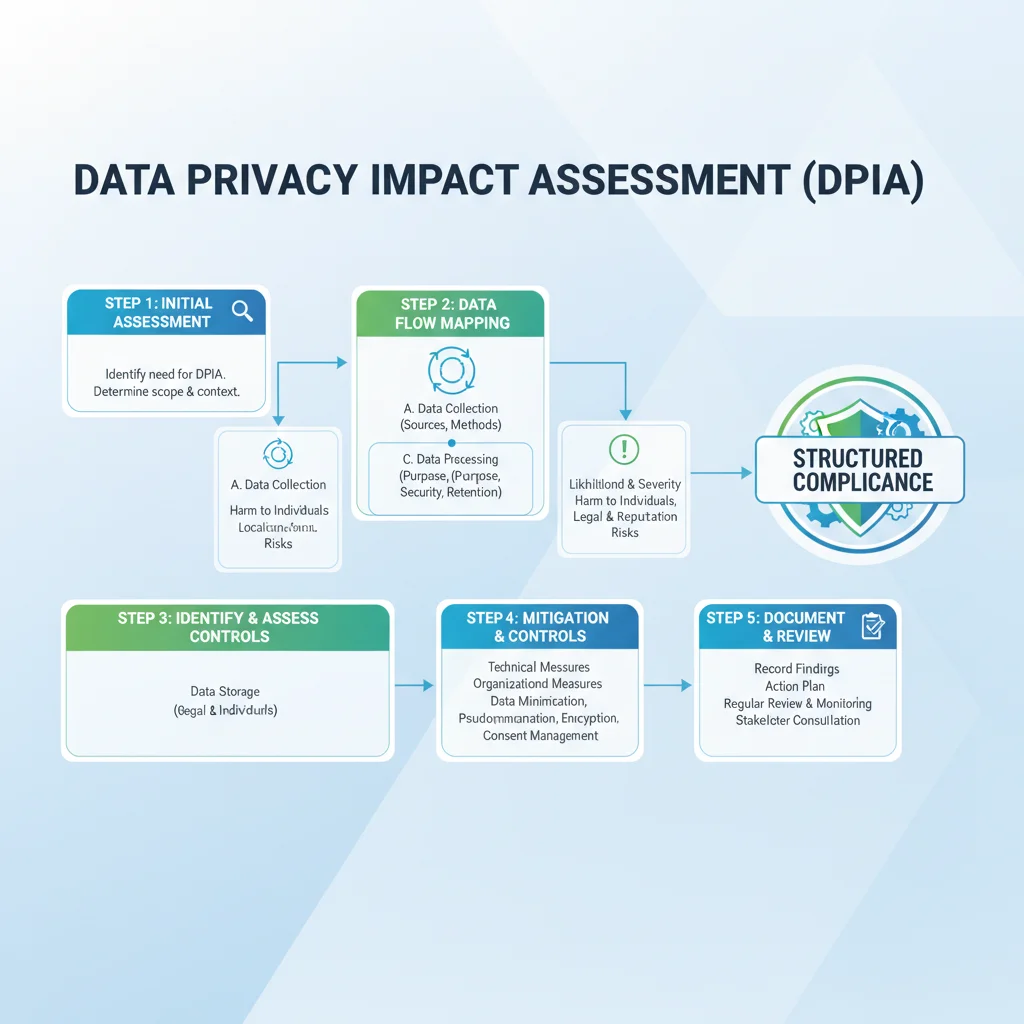
Many new state laws, mirroring GDPR, require organizations to conduct Data Protection Impact Assessments (DPIAs) or similar risk assessments for certain high-risk processing activities. A DPIA helps identify and mitigate privacy risks before new projects or systems that involve personal data are launched. This proactive approach is vital for demonstrating accountability and building privacy by design into your operations for US Data Privacy 2026.
7. Employee Training and Awareness
Human error remains a leading cause of data breaches. Regular and comprehensive employee training is crucial for fostering a privacy-aware culture. Training should cover:
- The importance of data privacy and the specific laws applicable to your organization.
- How to handle personal data securely and responsibly.
- Recognizing and reporting potential privacy incidents or breaches.
- The organization’s privacy policies and procedures.
Continuous education ensures that every employee understands their role in protecting personal information, contributing to overall compliance with US Data Privacy 2026.
The Role of Technology in US Data Privacy 2026 Compliance
Technology plays a dual role in data privacy: it creates new challenges but also offers powerful solutions for compliance. Leveraging appropriate privacy-enhancing technologies (PETs) and data governance tools can significantly streamline compliance efforts.
- Consent Management Platforms (CMPs): These tools help manage user consent for cookies and other data processing activities, ensuring compliance with opt-in/opt-out requirements across different jurisdictions.
- Data Discovery and Classification Tools: Automating the identification and classification of personal data across various systems can greatly assist in data mapping and inventory efforts.
- Automated Data Subject Request (DSR) Management Systems: These platforms help businesses efficiently receive, verify, and respond to consumer rights requests (access, deletion, etc.) within legal timelines.
- Data Loss Prevention (DLP) Solutions: DLP tools help prevent sensitive data from leaving the organization’s control, whether accidentally or maliciously.
- Privacy by Design Frameworks: Integrating privacy considerations into the design and architecture of systems and processes from the outset, rather than as an afterthought.
Investing in the right technological solutions can reduce the manual burden of compliance, enhance accuracy, and provide a scalable framework for managing the complexities of US Data Privacy 2026.
Building a Future-Proof Privacy Program
Given the ever-evolving nature of data privacy laws, particularly in the US, businesses need to build a privacy program that is not only compliant today but also adaptable to future changes. Here are strategies for future-proofing your approach to US Data Privacy 2026 and beyond:
1. Adopt a Holistic, Harmonized Approach
Instead of trying to comply with each state law individually, aim for a harmonized approach that meets the strictest requirements across all applicable jurisdictions. For instance, if one state requires opt-in consent for certain data processing, and another allows opt-out, adopting an opt-in standard for all relevant data processing can simplify compliance and reduce risk. This ‘highest common denominator’ strategy can save significant resources in the long run.
2. Appoint a Dedicated Privacy Officer or Team
For many organizations, especially those processing large volumes of personal data, appointing a dedicated privacy officer or establishing a privacy team is crucial. This individual or team will be responsible for overseeing compliance efforts, monitoring legislative changes, managing consumer requests, and fostering a culture of privacy within the organization. Their expertise will be invaluable in navigating the complexities of US Data Privacy 2026.

3. Regularly Review and Update Policies and Procedures
Data privacy laws are not static. New regulations are enacted, existing ones are amended, and enforcement guidance evolves. Your privacy policies, internal procedures, and compliance frameworks must be reviewed and updated regularly – at least annually, or whenever significant legislative changes occur. Staying informed through legal counsel, industry associations, and regulatory updates is essential for maintaining compliance with US Data Privacy 2026.
4. Prioritize Data Minimization and Purpose Limitation
Two core principles of modern data privacy are data minimization and purpose limitation. Data minimization dictates that you should only collect the personal data that is absolutely necessary for a specific purpose. Purpose limitation means that once collected, data should only be used for the purposes for which it was originally collected, or for compatible purposes. Adhering to these principles reduces the amount of data you hold, thereby reducing your risk exposure and simplifying compliance efforts for US Data Privacy 2026.
5. Embrace Privacy by Design and Default
Privacy by Design (PbD) is an approach that integrates privacy into the entire lifecycle of products, services, and systems, from the initial design phase to deployment and disposal. Privacy by Default means that personal data should be automatically protected in any IT system or business practice, without requiring individuals to take any action to protect their privacy. Embedding these principles into your organizational culture and technological infrastructure will ensure that privacy is a fundamental consideration, not an afterthought, as you tackle the challenges of US Data Privacy 2026.
Conclusion: Proactive Compliance is Key for US Data Privacy 2026
The landscape of US Data Privacy 2026 is characterized by increasing complexity, stricter enforcement, and empowered consumers. For businesses, this means that data privacy can no longer be a peripheral concern; it must be integrated into the core of their operations and business strategy. By understanding the current federal and state laws, anticipating future developments, and implementing robust compliance programs built on the pillars of transparency, security, and consumer rights, organizations can not only avoid penalties but also build invaluable trust with their customers.
Proactive engagement with data privacy, rather than reactive responses, will be the hallmark of successful businesses in the coming years. Investing in the right people, processes, and technology will be crucial for navigating the evolving demands of US Data Privacy 2026 and securing a sustainable, privacy-respecting future.