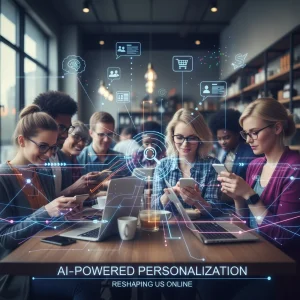
AI-Powered Personalization: Revolutionizing Digital Content Consumption by 2026
Anúncios
In an increasingly crowded digital world, the battle for consumer attention is fiercer than ever. Generic, one-size-fits-all content no longer cuts it. Consumers today expect experiences that are tailored, relevant, and engaging – a phenomenon driven largely by the advancements in Artificial Intelligence. The era of AI content personalization is not just a futuristic concept; it’s a present-day reality rapidly reshaping how we consume information, entertainment, and services online. Industry predictions suggest that by 2026, a staggering 70% of users will regularly interact with content shaped by AI, fundamentally altering the digital landscape.
This seismic shift presents both immense opportunities and significant challenges for businesses, content creators, and marketers. Understanding the mechanics, implications, and future trajectory of AI content personalization is no longer optional; it’s imperative for survival and growth in the digital economy. This comprehensive guide will explore the profound impact of AI on content consumption, delve into the technologies powering this revolution, examine the benefits and ethical considerations, and provide actionable strategies for harnessing the power of personalized digital experiences.
Anúncios
The Dawn of Hyper-Personalization: What is AI Content Personalization?
At its core, AI content personalization refers to the use of artificial intelligence and machine learning algorithms to deliver highly relevant and individualized content to users. Instead of presenting the same content to everyone, AI analyzes vast amounts of data – including user behavior, preferences, demographics, past interactions, and real-time context – to predict what content a specific user is most likely to find valuable, engaging, or interesting.
Beyond Simple Recommendations: The Evolution
Early forms of personalization were often based on rudimentary rules or collaborative filtering (e.g., ‘customers who bought this also bought that’). While effective to a degree, these methods lacked the sophistication to truly understand individual nuances. Modern AI content personalization goes far beyond this. It leverages advanced techniques such as:
- Machine Learning (ML): Algorithms that learn from data without being explicitly programmed, identifying patterns and making predictions.
- Natural Language Processing (NLP): Enables AI to understand, interpret, and generate human language, allowing for semantic understanding of content and user queries.
- Computer Vision: Allows AI to ‘see’ and interpret images and videos, enhancing content categorization and user interaction analysis.
- Reinforcement Learning: AI models learn by trial and error, optimizing content delivery based on user feedback and engagement metrics.
This technological prowess allows AI to create dynamic user profiles that evolve with each interaction, leading to increasingly accurate and compelling personalized experiences across various digital touchpoints. From news feeds and e-commerce product recommendations to streaming service suggestions and adaptive learning platforms, AI content personalization is quietly becoming the invisible hand guiding our digital journeys.
Anúncios
The Driving Force: Why 70% of Users Will Engage with AI-Driven Content by 2026
The projection that 70% of users will interact with AI-driven content by 2026 isn’t a random guess; it’s a trend rooted in several powerful factors:
1. Information Overload and the Need for Filtered Relevance
We are drowning in information. The sheer volume of content produced daily across the internet makes it impossible for any individual to sift through it all. AI content personalization acts as a powerful filter, cutting through the noise to present users with what they genuinely care about. This efficiency is invaluable in a time-scarce world, making AI-curated experiences a preferred choice.
2. Enhanced User Experience and Engagement
When content resonates deeply with an individual’s interests, needs, and preferences, engagement skyrockets. Personalized experiences lead to longer session times, higher conversion rates, and increased user satisfaction. Users are more likely to return to platforms that consistently offer them relevant and valuable content.
3. The Proliferation of AI-Powered Platforms
Major tech giants (Google, Amazon, Netflix, Meta, TikTok) have been at the forefront of implementing advanced AI for personalization. Their success has set a new standard, forcing other platforms and businesses across all sectors to adopt similar strategies to remain competitive. As AI tools become more accessible and sophisticated, even smaller entities can leverage AI content personalization.
4. Data Availability and Processing Power
The explosion of big data, coupled with advancements in cloud computing and AI hardware, provides the raw material and the processing capability needed for sophisticated personalization. Every click, view, purchase, and interaction generates data that AI can learn from, creating a virtuous cycle of improvement.
5. The ‘Expectation Effect’
As users become accustomed to personalized experiences on leading platforms, their expectations for all digital interactions rise. Generic content feels outdated and less valuable. This creates a demand-side pull for more AI content personalization across the web.
How AI Content Personalization is Implemented Across Industries
The applications of AI content personalization are vast and varied, touching almost every digital industry:
E-commerce and Retail
This is perhaps one of the most visible applications. AI analyzes browsing history, purchase patterns, wish lists, and even real-time behavior to recommend products, personalize promotions, and tailor the entire shopping experience. This leads to increased sales, higher average order values, and improved customer loyalty.
Media and Entertainment
Streaming services like Netflix and Spotify are masters of AI content personalization. They recommend movies, shows, and music based on viewing/listening history, ratings, genre preferences, and even time of day. News outlets use AI to curate personalized news feeds, ensuring readers see stories most relevant to their interests.
Education and E-Learning
AI is transforming education by adapting learning paths, recommending resources, and providing personalized feedback based on a student’s learning style, pace, and performance. This creates more engaging and effective learning experiences.
Marketing and Advertising
From dynamic ad creatives that change based on user profiles to personalized email campaigns and website content, AI enables marketers to deliver the right message to the right person at the right time, drastically improving campaign effectiveness and ROI.
Healthcare
AI can personalize health advice, treatment plans, medication reminders, and even mental health support based on an individual’s medical history, genetic data, lifestyle, and real-time health metrics. This promises more effective and preventative healthcare.

The Mechanics: Technologies Powering AI Content Personalization
Underneath the seamless user experience of AI content personalization lies a sophisticated interplay of technologies:
1. Data Collection and Analysis
The foundation of any personalization effort is data. AI systems collect explicit data (user-provided preferences, demographic info) and implicit data (browsing history, click-through rates, time spent on content, scroll depth, purchase history, device type, location, etc.). Advanced analytics and big data platforms then process this information.
2. User Profiling
AI builds dynamic, rich profiles for each user or user segment. These profiles are not static; they continuously update as the user interacts with content. They can include preferences, interests, intent (e.g., ‘looking to buy a new laptop’), behavioral patterns, and even emotional states inferred from interactions.
3. Recommendation Engines
These are the core of AI content personalization. They employ various algorithms:
- Collaborative Filtering: Recommends items based on the preferences of similar users.
- Content-Based Filtering: Recommends items similar to those a user has liked in the past.
- Hybrid Methods: Combine collaborative and content-based approaches for more robust recommendations.
- Deep Learning Models: Neural networks can identify complex, non-linear relationships in data, leading to highly accurate and novel recommendations.
4. Content Tagging and Categorization
AI uses NLP and computer vision to automatically tag and categorize content with relevant keywords, topics, and attributes. This allows the recommendation engine to match user profiles with appropriate content more effectively.
5. Real-time Adaptation
The most advanced personalization systems can adapt in real-time. If a user’s behavior changes within a single session (e.g., they click on a new category of products), the AI can immediately adjust the content presented to them, making the experience highly dynamic and responsive.
Benefits of Embracing AI Content Personalization
For businesses and content providers, the advantages of adopting AI content personalization are compelling:
- Increased Engagement: Highly relevant content keeps users on platforms longer, reducing bounce rates and increasing time spent.
- Higher Conversion Rates: Personalized product recommendations and targeted offers lead to more purchases and sign-ups.
- Improved Customer Loyalty: Users feel understood and valued when platforms cater to their individual needs, fostering stronger relationships and repeat business.
- Enhanced Data Insights: The process of personalization generates even more granular data, providing deeper insights into customer behavior and preferences.
- Competitive Advantage: Businesses that effectively personalize stand out in crowded markets, attracting and retaining more customers.
- Optimized Content Strategy: AI can highlight which content types perform best for different segments, informing future content creation efforts.
- Reduced Marketing Spend: By targeting the right audience with the right message, marketing campaigns become more efficient, leading to a better ROI.
Challenges and Ethical Considerations in AI Content Personalization
While the benefits are clear, the widespread adoption of AI content personalization also brings important challenges and ethical dilemmas that must be addressed.
1. Data Privacy and Security
Personalization relies heavily on user data. Ensuring this data is collected, stored, and used ethically and securely is paramount. Breaches of trust can lead to significant reputational and financial damage. Compliance with regulations like GDPR and CCPA is crucial.
2. The Filter Bubble and Echo Chambers
By constantly showing users content that aligns with their existing preferences, AI can inadvertently create ‘filter bubbles’ or ‘echo chambers.’ Users may be exposed only to information that confirms their existing beliefs, limiting their exposure to diverse viewpoints and potentially reinforcing biases. This has significant societal implications, particularly in news consumption.
3. Algorithmic Bias
AI algorithms are only as unbiased as the data they are trained on. If the training data contains historical biases (e.g., related to gender, race, socioeconomic status), the AI can perpetuate and even amplify these biases in its recommendations, leading to unfair or discriminatory outcomes.
4. Transparency and Explainability
Users often don’t understand why certain content is recommended to them. The ‘black box’ nature of some AI models can lead to a lack of trust. Companies need to strive for greater transparency and explainability in their personalization algorithms.
5. Over-Personalization and ‘Creepiness’
While users appreciate relevance, there’s a fine line between helpful personalization and intrusive ‘creepiness.’ When AI seems to know too much or predicts needs too accurately, it can make users uncomfortable. Finding the right balance is key.

Strategies for Implementing Effective AI Content Personalization
For organizations looking to leverage AI content personalization, a strategic approach is essential:
1. Define Clear Goals
What do you want to achieve? Increased sales, higher engagement, better customer satisfaction, reduced churn? Clear objectives will guide your personalization strategy and help measure success.
2. Invest in Data Infrastructure and Quality
Garbage in, garbage out. Ensure you have robust systems for collecting, cleaning, storing, and analyzing data. Data quality is paramount for effective AI. Implement a strong data governance framework.
3. Start Small and Iterate
You don’t need to personalize everything at once. Start with a specific area (e.g., product recommendations on a homepage, personalized email subject lines) and expand as you learn and gain confidence. A/B test different personalization strategies.
4. Choose the Right AI Tools and Platforms
Whether building in-house or using third-party solutions, select tools that align with your needs, budget, and technical capabilities. Consider platforms that offer flexibility, scalability, and good integration capabilities.
5. Focus on User Experience (UX)
Personalization should enhance, not detract from, the user experience. Ensure personalized elements are seamlessly integrated and genuinely helpful. Continuously gather user feedback.
6. Prioritize Privacy and Transparency
Be transparent with users about what data you collect and how it’s used. Offer clear privacy policies and give users control over their data and personalization preferences. Build trust.
7. Monitor and Optimize Continuously
AI models require ongoing monitoring and retraining. Track key performance indicators (KPIs) related to your goals, analyze results, and continuously refine your personalization algorithms and strategies.
8. Balance Personalization with Serendipity
While personalization is key, occasionally introducing novel or unexpected content can prevent filter bubbles and expose users to new interests. Design your algorithms to allow for a degree of serendipitous discovery.
The Future is Personalized: Beyond 2026
As we look beyond 2026, the evolution of AI content personalization will continue at a rapid pace. We can anticipate:
- More Sophisticated Contextual Understanding: AI will better understand not just what users like, but also their current intent, emotional state, and environmental context (e.g., time of day, weather, device).
- Generative AI for Personalized Content Creation: AI won’t just recommend existing content; it will increasingly generate unique, personalized content (text, images, video) on the fly, tailored to individual users.
- Hyper-Personalized Interfaces: Entire user interfaces and digital environments will dynamically reconfigure based on individual preferences and needs, making every digital interaction truly unique.
- Ethical AI Frameworks: Greater emphasis will be placed on developing and implementing ethical AI guidelines to mitigate biases, protect privacy, and ensure fairness in personalization.
- Cross-Platform and Omnichannel Personalization: Seamless, consistent personalized experiences will extend across all devices and touchpoints, both online and offline.
Conclusion
The shift towards AI content personalization is undeniable and transformative. With 70% of users projected to engage with AI-driven content by 2026, businesses and content creators who fail to adapt risk being left behind. The ability to deliver relevant, engaging, and individualized experiences is no longer a luxury but a fundamental expectation of the modern digital consumer.
By understanding the technologies, embracing the benefits, and proactively addressing the ethical challenges, organizations can harness the immense power of AI to forge deeper connections with their audiences, drive unprecedented engagement, and unlock new avenues for growth in the personalized digital future. The journey to hyper-personalization is ongoing, and those who embark on it strategically will be the ones to thrive.