AI in Cybersecurity: Revolutionizing Threat Detection by 30% by 2026

Anúncios
In the rapidly evolving digital landscape, the battle against cyber threats is a relentless arms race. Traditional cybersecurity measures, while foundational, are increasingly struggling to keep pace with the sophistication and sheer volume of attacks. Enter Artificial Intelligence (AI) and Machine Learning (ML), technologies poised to revolutionize how we detect, prevent, and respond to cyber threats. The promise is significant: industry experts project that AI will enhance cybersecurity threat detection capabilities by an astounding 30% by 2026. This isn’t just a marginal improvement; it’s a paradigm shift that will redefine the future of digital security.
Anúncios
The Escalating Cyber Threat Landscape
Before delving into AI’s transformative power, it’s crucial to understand the challenges that necessitate such advanced solutions. Cybercriminals are becoming more organized, leveraging sophisticated techniques like polymorphic malware, advanced persistent threats (APTs), and highly targeted phishing campaigns. The attack surface has also expanded dramatically with the proliferation of IoT devices, cloud computing, and remote workforces. Security teams are often overwhelmed by a deluge of alerts, many of which are false positives, leading to alert fatigue and the potential for genuine threats to be missed. The sheer volume of data generated daily makes manual analysis virtually impossible, creating a critical need for automated, intelligent solutions.
Limitations of Traditional Cybersecurity
Traditional cybersecurity relies heavily on signature-based detection, where known threat patterns are identified and blocked. While effective against known threats, this approach falls short when confronted with zero-day attacks or novel malware variants. Rule-based systems also require constant updates and human intervention, making them reactive rather than proactive. Moreover, the lack of contextual awareness often means that isolated suspicious activities are not connected to form a broader attack narrative, leaving organizations vulnerable to multi-stage attacks.
How AI and Machine Learning are Reshaping Cybersecurity
AI in cybersecurity offers a powerful antidote to these limitations. Machine learning, a subset of AI, enables systems to learn from data, identify patterns, and make predictions without explicit programming. This capability is particularly potent in cybersecurity, where identifying anomalies and predicting potential threats are paramount. The integration of AI and ML into security operations centers (SOCs) is fundamentally changing how security teams operate, moving them from a reactive stance to a more proactive and predictive one.
Real-time Threat Detection and Anomaly Identification
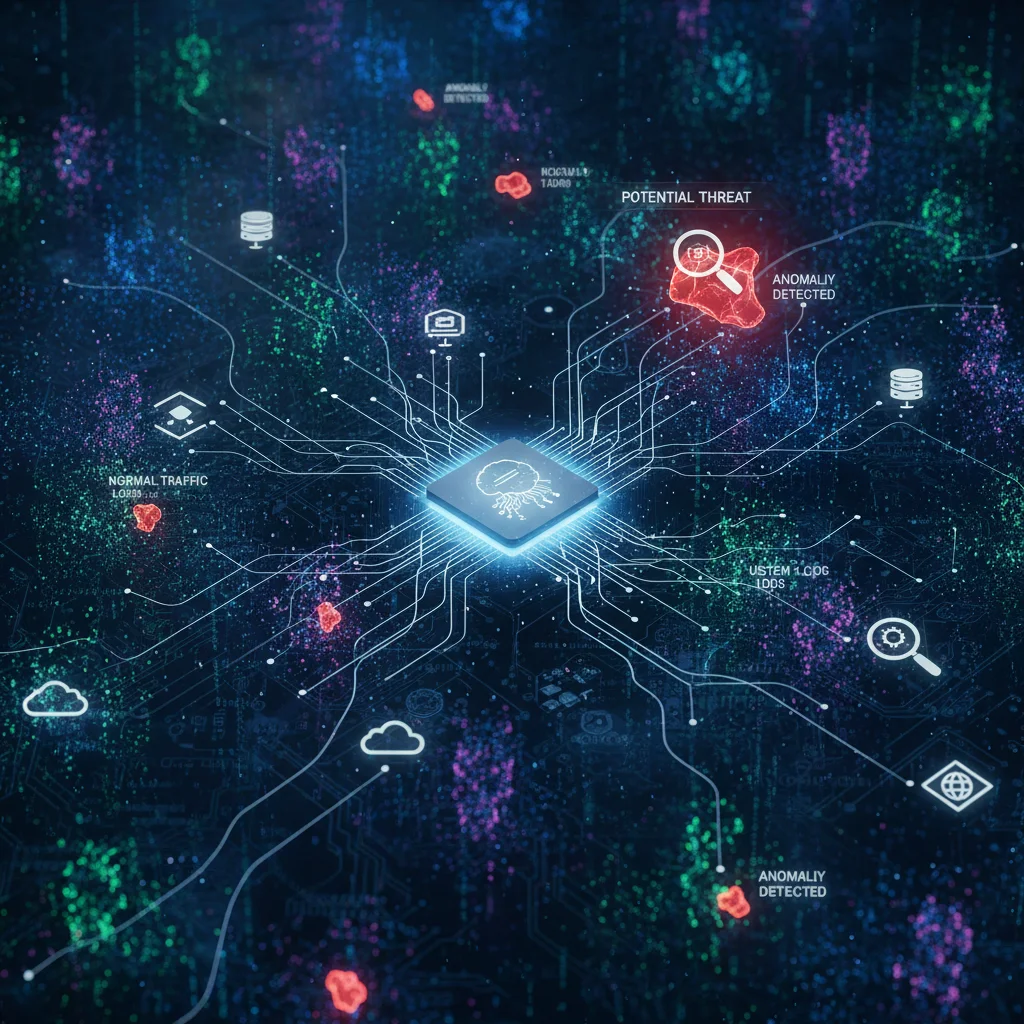
One of the most significant contributions of AI to cybersecurity is its ability to perform real-time threat detection. AI algorithms can continuously monitor network traffic, system logs, and user behavior, establishing a baseline of normal activity. Any deviation from this baseline, no matter how subtle, can be flagged as anomalous. This is particularly effective against zero-day exploits and novel attack vectors that signature-based systems would miss. For instance, an AI system can detect unusual login patterns, sudden spikes in data egress, or the execution of unfamiliar processes, all indicative of a potential breach.
Anúncios
Behavioral Analytics and User Entity Behavior Analytics (UEBA)
AI-driven User and Entity Behavior Analytics (UEBA) are critical for identifying insider threats and compromised accounts. UEBA platforms use machine learning to build comprehensive profiles of individual users and entities (like servers or applications) based on their historical activities. If a user suddenly accesses sensitive files they’ve never touched before, or a server starts communicating with an unusual external IP address, the AI can detect this deviation and generate an alert. This capability is invaluable for catching threats that might otherwise blend in with legitimate traffic.
Automated Incident Response
Beyond detection, AI is also streamlining incident response. Security Orchestration, Automation, and Response (SOAR) platforms leverage AI to automate repetitive tasks, correlate alerts from various security tools, and even initiate containment actions. For example, upon detecting a phishing attempt, an AI-powered SOAR system could automatically block the malicious sender, quarantine affected endpoints, and initiate a forensic investigation, significantly reducing response times and minimizing damage.
Predictive Analytics and Threat Intelligence
The predictive capabilities of AI are transforming threat intelligence. By analyzing vast amounts of global threat data, including dark web activity, malware samples, and attack campaigns, AI can identify emerging threat trends and vulnerabilities. This allows organizations to proactively strengthen their defenses against anticipated attacks, rather than waiting for them to occur. AI can also predict which assets are most likely to be targeted, enabling security teams to prioritize their efforts and allocate resources more effectively.
Machine Learning Techniques Driving Cybersecurity Innovation
Several machine learning techniques are at the forefront of this cybersecurity revolution. Understanding these techniques helps to appreciate the depth of AI’s impact.
Supervised Learning
Supervised learning models are trained on labeled datasets containing examples of both benign and malicious activities. The model learns to classify new, unseen data based on these examples. This is commonly used for malware detection, spam filtering, and intrusion detection systems where a clear distinction between good and bad data can be provided.
Unsupervised Learning
Unsupervised learning, conversely, works with unlabeled data to find hidden patterns and structures. In cybersecurity, this is particularly useful for anomaly detection. Algorithms like clustering can group similar behaviors, making it easier to spot outliers that might indicate a threat. This is crucial for detecting zero-day attacks where no prior knowledge of the threat exists.
Deep Learning
Deep learning, a more advanced form of machine learning, uses artificial neural networks with multiple layers to learn complex patterns. These networks are exceptionally good at processing unstructured data like network packets, system logs, and even natural language (for phishing detection). Deep learning models can identify subtle indicators of compromise that might escape traditional ML algorithms, leading to higher accuracy in threat detection.
Reinforcement Learning
Reinforcement learning involves training agents to make decisions by rewarding desired actions and penalizing undesirable ones. While still an emerging area in cybersecurity, it holds promise for autonomous defense systems that can learn to adapt and respond to threats in real-time without human intervention, effectively creating self-healing networks.
The Projected 30% Increase in Threat Detection by 2026
The projection of a 30% increase in threat detection by 2026 is based on several factors, including the continuous advancement of AI algorithms, the growing availability of computational power, and the increasing adoption of AI-powered security solutions across industries. This isn’t merely about detecting more threats; it’s about detecting them faster, with greater accuracy, and with fewer false positives. The impact will be felt across all aspects of cybersecurity:
- Reduced Mean Time To Detect (MTTD): AI significantly shrinks the time it takes to identify a breach, often reducing it from days or weeks to minutes or even seconds.
- Improved Mean Time To Respond (MTTR): Automated response capabilities driven by AI will drastically cut down the time required to contain and remediate incidents.
- Lower False Positive Rates: Advanced ML models can differentiate between benign anomalies and genuine threats more effectively, reducing alert fatigue for security analysts.
- Enhanced Predictive Capabilities: AI’s ability to analyze vast datasets allows for better anticipation of future attacks, enabling proactive defense strategies.
- Better Resource Utilization: By automating mundane tasks and prioritizing critical alerts, AI frees up human security experts to focus on strategic analysis and complex problem-solving.
This 30% increase isn’t a static target but a continuous improvement curve. As AI models are fed more data and become more sophisticated, their ability to discern and neutralize threats will only grow.
Challenges and Considerations for AI in Cybersecurity
While the benefits are clear, the widespread adoption of AI in cybersecurity also presents several challenges that need to be addressed.
Data Quality and Bias
AI models are only as good as the data they are trained on. Poor quality, incomplete, or biased data can lead to ineffective or even discriminatory security decisions. Ensuring diverse and representative datasets is crucial for building robust AI systems.
Adversarial AI
Cybercriminals are also exploring the use of AI. Adversarial AI involves techniques where attackers try to trick AI models by subtly altering inputs to evade detection or even manipulate the AI’s learning process. Developing AI systems that are resilient to these attacks is a significant ongoing research area.
Complexity and Explainability
Deep learning models, in particular, can be complex ‘black boxes,’ making it difficult for human analysts to understand why a particular decision was made. This lack of explainability (XAI) can be a hurdle in regulated industries where transparency and auditability are critical. Future AI development needs to focus on creating more interpretable models.
Integration and Skill Gap
Integrating AI solutions into existing cybersecurity infrastructures can be complex. Furthermore, there’s a growing skill gap in the cybersecurity workforce, with a shortage of professionals who possess expertise in both cybersecurity and AI/ML. Training and upskilling initiatives are essential to bridge this gap.
The Human Element: Collaboration, Not Replacement
It’s important to emphasize that AI is not intended to replace human cybersecurity professionals but to augment their capabilities. The vision for the future of cybersecurity is one of human-AI collaboration. AI handles the heavy lifting of data analysis, anomaly detection, and automated responses, allowing human analysts to focus on strategic planning, complex investigations, and decision-making that requires nuanced judgment and creativity. Humans are essential for interpreting AI outputs, addressing false positives, and adapting to novel threats that even the most advanced AI might initially struggle with.

Ethical Considerations
As AI becomes more pervasive in cybersecurity, ethical considerations come to the forefront. Issues such as privacy, surveillance, and the potential for misuse of AI technologies need careful consideration. Organizations must establish clear ethical guidelines and ensure that AI deployments align with legal and societal norms.
Future Outlook: Beyond 2026
The 30% increase in threat detection by 2026 is just the beginning. Looking further ahead, AI is expected to drive even more profound changes in cybersecurity:
- Autonomous Security Systems: Networks that can autonomously detect, analyze, and neutralize threats with minimal human intervention.
- Proactive Threat Hunting: AI systems that actively seek out vulnerabilities and potential attack paths before adversaries can exploit them.
- Self-Healing Networks: Systems capable of automatically reconfiguring themselves to isolate compromised segments and restore normal operations.
- Quantum-Resistant Cryptography: While not purely AI, AI will play a role in developing and deploying cryptographic solutions resilient to quantum computing attacks.
- Enhanced Cyber-Physical System Security: Protecting critical infrastructure, industrial control systems, and IoT devices with AI-powered defenses.
The continuous feedback loop between AI models, new threat intelligence, and human expertise will ensure that cybersecurity remains dynamic and adaptive. Organizations that invest in AI and foster a culture of innovation will be best positioned to thrive in this increasingly complex digital world.
Implementing AI in Your Cybersecurity Strategy
For organizations looking to leverage the power of AI in cybersecurity, a phased approach is often most effective:
- Assess Current Capabilities: Understand existing security posture, tools, and pain points where AI can offer the most significant improvements.
- Define Clear Objectives: Identify specific security challenges that AI should address, such as reducing false positives, improving detection of specific threat types, or automating incident response.
- Start Small with Pilot Projects: Begin with focused AI deployments in areas like endpoint detection and response (EDR) or network traffic analysis to gain experience and demonstrate value.
- Invest in Data Infrastructure: Ensure robust data collection, storage, and processing capabilities, as high-quality data is the lifeblood of effective AI.
- Develop or Acquire AI Expertise: Build internal teams with AI and cybersecurity skills or partner with vendors specializing in AI-powered security solutions.
- Continuously Monitor and Refine: AI models require ongoing monitoring, retraining, and optimization to remain effective against evolving threats.
- Foster Human-AI Collaboration: Train security analysts on how to work effectively with AI tools, understanding their strengths and limitations.
The journey towards an AI-enhanced cybersecurity framework is not without its complexities, but the rewards in terms of enhanced protection, efficiency, and resilience are undeniable. The projected 30% increase in threat detection by 2026 is a testament to the transformative potential of AI in safeguarding our digital future.
Conclusion
The integration of AI and machine learning into cybersecurity is no longer a futuristic concept; it is a present reality and a critical necessity. As cyber threats grow in sophistication and scale, AI provides the intelligence, speed, and automation required to stay ahead of adversaries. The projected 30% boost in threat detection by 2026 underscores AI’s pivotal role in fortifying our digital defenses. By embracing AI, organizations can move towards a more proactive, predictive, and resilient cybersecurity posture, ensuring the safety and integrity of their most valuable digital assets in an ever-challenging threat landscape. The future of cybersecurity is undeniably intertwined with the continuous innovation and strategic deployment of AI technologies.