Zero-Trust Architecture: Why 70% of US Enterprises Are Adopting It by 2026 for Enhanced Digital Security

Anúncios
In an era where cyber threats are not just growing in volume but also in sophistication, the traditional perimeter-based security model is proving increasingly inadequate. The digital landscape for US enterprises is rapidly evolving, characterized by hybrid workforces, cloud adoption, and a proliferation of connected devices. This complex environment demands a fundamental shift in how organizations approach security. Enter Zero-Trust Architecture, a paradigm that is quickly becoming the gold standard for digital protection. Industry projections indicate a staggering 70% of US enterprises are set to adopt this revolutionary framework by 2026, marking a pivotal moment in the fight for enhanced digital security.
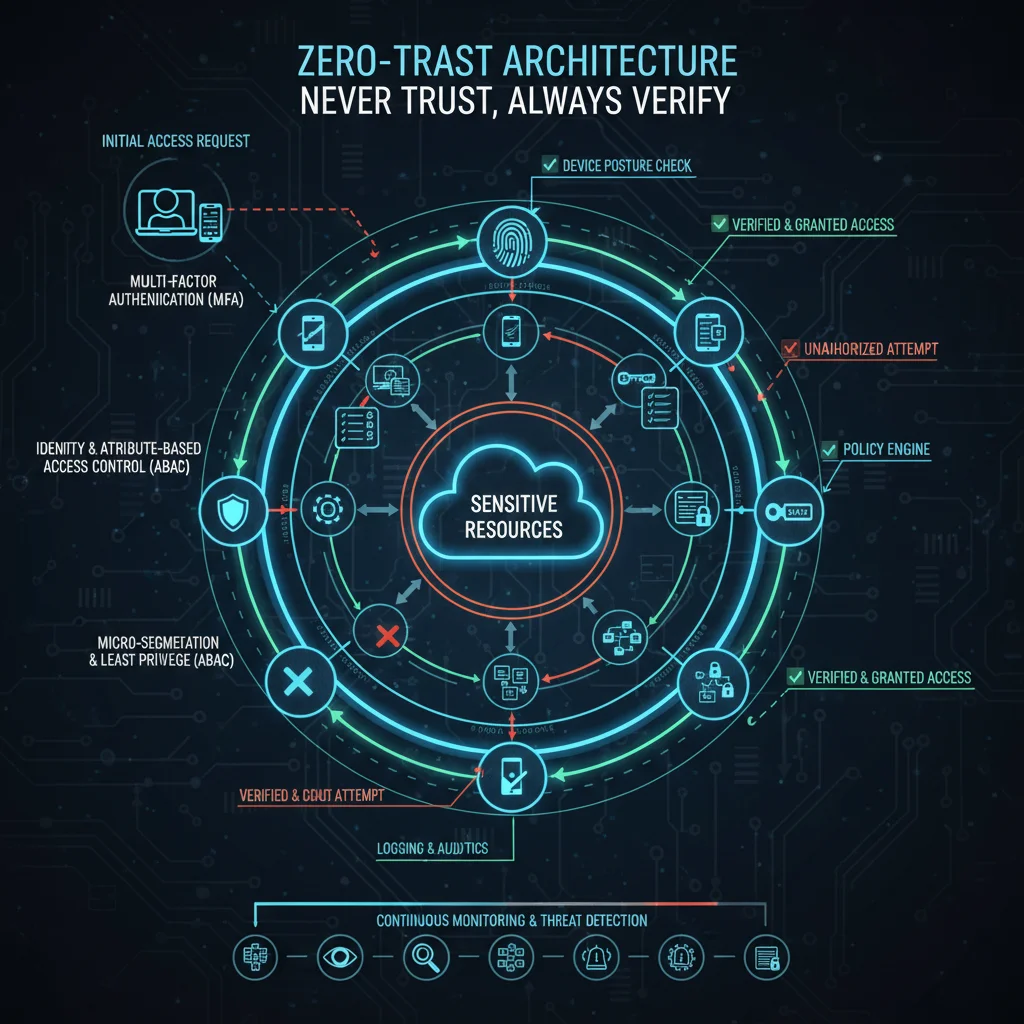
The imperative for this widespread adoption of zero trust security is clear: breaches are costly, reputation-damaging, and increasingly frequent. Traditional security models, often likened to a castle-and-moat defense, assume that everything inside the network perimeter is trustworthy. This assumption, however, crumbles when an attacker inevitably gains access to the internal network, allowing them to move laterally with little resistance. Zero-Trust Architecture dismantles this outdated premise, operating on the principle of ‘never trust, always verify.’ Every user, device, application, and data flow, regardless of its location relative to the network perimeter, must be authenticated, authorized, and continuously validated before being granted access to resources.
Anúncios
This article delves into the core tenets of Zero-Trust Architecture, exploring why it’s gaining such significant traction among US enterprises. We will examine the critical drivers behind its adoption, the tangible benefits it offers, and the challenges organizations face in its implementation. By understanding the strategic importance of zero trust security, businesses can better prepare for a future where digital resilience is not just an advantage, but a necessity.
The Fundamental Shift: Understanding Zero-Trust Principles
At its heart, Zero-Trust Architecture is not a single technology but a strategic approach to security built on several core principles. These principles represent a radical departure from conventional security paradigms and are essential for mitigating modern cyber risks.
1. Never Trust, Always Verify: The Core Mantra
This is the foundational principle of zero trust security. It mandates that no user or device, whether internal or external to the network, should be implicitly trusted. All access requests must be rigorously authenticated and authorized before access is granted. This means that even if a user is already inside the corporate network, their identity and the health of their device are continually re-evaluated for each access attempt to a sensitive resource. This continuous verification process drastically reduces the attack surface and prevents unauthorized lateral movement within the network.
Anúncios
2. Micro-segmentation: Granular Access Control
Micro-segmentation is a critical component of Zero-Trust Architecture. Instead of broad network segments, micro-segmentation divides the network into small, isolated segments, each with its own granular security policies. This ensures that even if an attacker compromises one segment, their ability to move to other segments is severely restricted. For instance, a finance application might be in its own micro-segment, accessible only by authorized finance personnel from approved devices, and only after specific authentication checks. This fine-grained control is a powerful defense against advanced persistent threats (APTs) and insider threats.
3. Least Privilege Access: Minimizing Exposure
The principle of least privilege dictates that users and devices should only be granted the minimum level of access necessary to perform their required tasks. This minimizes the potential damage if an account or device is compromised. For example, a marketing employee doesn’t need access to sensitive HR records, and a development server doesn’t need access to production databases unless explicitly required and authorized. Implementing least privilege access across all systems and applications is a cornerstone of robust zero trust security.
4. Device Health and Contextual Awareness: Beyond Identity
Zero-Trust Architecture extends beyond just user identity to include the health and context of the devices requesting access. This involves assessing factors such as the device’s patching status, presence of security software, geographical location, time of access, and the nature of the resource being accessed. A device that is out of compliance with security policies (e.g., missing critical updates) might be denied access or granted only limited access until it’s remediated. This dynamic evaluation adds another layer of security, ensuring that only trusted devices can access sensitive resources.
5. Continuous Monitoring and Threat Detection
A static security posture is insufficient in today’s dynamic threat landscape. Zero-Trust Architecture emphasizes continuous monitoring of user and device behavior, network traffic, and system logs to detect anomalies and potential threats in real-time. Security information and event management (SIEM) systems, security orchestration, automation, and response (SOAR) platforms, and user and entity behavior analytics (UEBA) tools play crucial roles in this continuous vigilance. Any suspicious activity triggers immediate alerts and automated responses, reinforcing the ‘always verify’ aspect of zero trust security.
Why US Enterprises Are Embracing Zero Trust Security
The rapid adoption rate of Zero-Trust Architecture among US enterprises is driven by a confluence of factors, each highlighting the limitations of traditional security models in the face of modern challenges.
Evolving Threat Landscape and Sophisticated Attacks
Cybercriminals are no longer relying solely on external attacks. Phishing, ransomware, supply chain attacks, and sophisticated insider threats are increasingly common. These attacks often bypass traditional perimeter defenses by compromising legitimate credentials or exploiting vulnerabilities within trusted internal networks. Zero-Trust Architecture provides a robust defense against these evolving threats by treating every access request as potentially malicious, thereby significantly reducing the impact of a breach.
The Rise of Hybrid and Remote Work
The pandemic accelerated the shift to hybrid and remote work models, blurring the lines of the traditional network perimeter. Employees are accessing corporate resources from various locations, using diverse devices, and connecting to public and private networks. This distributed environment makes it challenging to enforce consistent security policies using a perimeter-centric approach. Zero-Trust Architecture is inherently designed for this borderless environment, ensuring secure access regardless of location or network. Every connection, whether from the office or a home Wi-Fi network, undergoes the same rigorous verification processes, making it a critical enabler for secure remote operations.
Cloud Adoption and SaaS Proliferation
Enterprises are increasingly migrating their infrastructure and applications to the cloud, utilizing Software-as-a-Service (SaaS) solutions and Infrastructure-as-a-Service (IaaS) platforms. This distributed data and application landscape extends beyond the traditional data center, making a perimeter-based security model obsolete. Zero-Trust Architecture seamlessly integrates with cloud environments, providing consistent security policies across on-premises, hybrid, and multi-cloud deployments. It ensures that access to cloud resources is just as secure as access to internal servers, reinforcing the importance of zero trust security in cloud strategies.
Compliance and Regulatory Pressures
Regulatory bodies and industry standards are increasingly emphasizing robust data protection and access control. Frameworks like GDPR, CCPA, HIPAA, and NIST all align with the principles of Zero-Trust Architecture, promoting granular access control, continuous monitoring, and strong authentication. Adopting zero trust security not only enhances an organization’s security posture but also significantly aids in meeting stringent compliance requirements, mitigating legal and financial risks associated with data breaches.
Reducing the Risk and Cost of Data Breaches
The financial and reputational costs of a data breach can be devastating. Beyond direct financial losses from remediation, legal fees, and regulatory fines, breaches can erode customer trust and damage brand image. By limiting lateral movement and ensuring granular access control, Zero-Trust Architecture significantly reduces the likelihood and impact of successful cyberattacks. Even if a breach occurs, the damage is contained to a much smaller segment of the network, minimizing data exfiltration and business disruption. This proactive defense makes zero trust security an essential investment.
Key Benefits of Implementing Zero-Trust Architecture
The widespread adoption of Zero-Trust Architecture is a testament to the tangible benefits it delivers to US enterprises. These advantages span across security, operational efficiency, and business resilience.
Enhanced Security Posture
By eliminating implicit trust, Zero-Trust Architecture dramatically strengthens an organization’s overall security posture. It provides a more resilient defense against a wide array of cyber threats, including phishing, ransomware, insider threats, and sophisticated nation-state attacks. The continuous verification and least privilege principles ensure that even if an initial compromise occurs, the attacker’s ability to escalate privileges or move laterally is severely hampered.
Improved Visibility and Control
Implementing zero trust security requires a deep understanding of all users, devices, applications, and data flows within an organization. This process inherently leads to improved visibility into the IT environment. With granular control over access policies and continuous monitoring, security teams gain unprecedented insight into who is accessing what, from where, and with what device. This enhanced visibility is crucial for proactive threat detection and incident response.
Simplified Compliance and Audit Trails
The granular access controls and detailed logging inherent in Zero-Trust Architecture simplify compliance efforts. Organizations can easily demonstrate adherence to various regulatory requirements by providing comprehensive audit trails of all access attempts and policy enforcement. This reduces the burden of compliance audits and provides greater assurance to stakeholders regarding data protection practices, making zero trust security a clear advantage for regulatory adherence.
Agility and Flexibility for Digital Transformation
As enterprises undergo digital transformation, adopting cloud services, IoT, and new business applications, security needs to be agile and adaptable. Zero-Trust Architecture provides this flexibility, enabling secure adoption of new technologies and business models without compromising security. It allows organizations to extend security policies consistently across hybrid and multi-cloud environments, supporting innovation while maintaining a strong defense. This adaptability is key for businesses looking to leverage new technologies securely.
Reduced Operational Costs in the Long Run
While the initial implementation of Zero-Trust Architecture can involve significant investment, it often leads to reduced operational costs in the long run. By preventing costly data breaches, minimizing downtime, and streamlining compliance, organizations can realize substantial savings. Furthermore, automated policy enforcement and integrated security tools can reduce the manual effort required for security management, optimizing resource allocation within the IT security department.
Challenges and Considerations in Zero-Trust Implementation
Despite its compelling benefits, implementing Zero-Trust Architecture is not without its challenges. Enterprises must approach this transformation strategically, addressing various technical, operational, and cultural hurdles.
Complexity of Existing IT Environments
Many US enterprises operate with legacy systems, complex network architectures, and a multitude of applications. Integrating zero trust security principles into such environments can be challenging, requiring careful planning and a phased approach. Identifying all assets, mapping data flows, and defining granular access policies for every resource can be an arduous task, necessitating comprehensive discovery and assessment phases.
Organizational Buy-in and Cultural Shift
The ‘never trust, always verify’ mentality represents a significant cultural shift for many organizations. It requires buy-in from leadership, IT teams, and end-users. Resistance to change, particularly concerning new authentication processes or restricted access, can hinder adoption. Effective communication, training, and change management strategies are crucial to ensure a smooth transition and foster a security-first culture.

Integration with Existing Security Tools
Enterprises typically have an existing stack of security tools, including firewalls, intrusion detection systems, and identity management solutions. Integrating these disparate tools into a cohesive Zero-Trust Architecture can be complex. It often requires careful orchestration, API integrations, and potentially investing in new technologies that facilitate a unified security policy enforcement across the entire IT ecosystem. Compatibility and interoperability are key considerations.
Defining and Enforcing Granular Policies
Creating and managing thousands of granular access policies for every user, device, and application can be overwhelming. Organizations need robust policy management tools and automated systems to define, enforce, and continuously adapt these policies. Without proper automation and clear policy frameworks, the complexity can lead to misconfigurations and security gaps, undermining the effectiveness of zero trust security.
Continuous Monitoring and Incident Response
The continuous monitoring aspect of Zero-Trust Architecture generates a vast amount of data. Effectively analyzing this data, identifying anomalies, and responding to incidents in real-time requires advanced analytics capabilities, skilled security personnel, and well-defined incident response playbooks. Enterprises must invest in security operations center (SOC) capabilities and automation to leverage the full potential of continuous monitoring.
The Roadmap to Zero-Trust Adoption: Best Practices for Enterprises
For US enterprises aiming to join the 70% adopting Zero-Trust Architecture by 2026, a structured and strategic roadmap is essential. Here are some best practices for successful implementation:
- Start Small, Think Big: Begin with a pilot project in a less critical but representative area of the business. This allows teams to gain experience, refine processes, and demonstrate early success before scaling across the entire organization.
- Identify and Protect Critical Assets: Prioritize the protection of the most valuable data and applications. Understand where sensitive information resides, who needs access, and under what conditions. This forms the foundation for defining initial micro-segments and access policies.
- Strengthen Identity and Access Management (IAM): A robust IAM solution is the cornerstone of zero trust security. Implement multi-factor authentication (MFA) everywhere, leverage strong authentication protocols, and establish clear roles and responsibilities for access governance.
- Gain Visibility into Your Network and Data Flows: Before you can secure something, you must understand it. Use network monitoring tools, endpoint detection and response (EDR) solutions, and data loss prevention (DLP) technologies to gain comprehensive visibility into user activity, device posture, and data movement.
- Automate Policy Enforcement: Manual policy enforcement is unsustainable at scale. Invest in security orchestration, automation, and response (SOAR) platforms and policy engines that can automate access decisions based on real-time context and predefined rules.
- Educate and Train Your Workforce: Ensure that all employees understand the importance of Zero-Trust Architecture and their role in maintaining security. Provide training on new tools, authentication processes, and security best practices to foster a security-aware culture.
- Continuously Monitor and Adapt: Zero trust security is an ongoing journey, not a destination. Continuously monitor your environment for new threats, review and update policies, and adapt your architecture as your business needs and the threat landscape evolve. Regular penetration testing and vulnerability assessments are also crucial.
- Leverage Vendor Expertise: Work with cybersecurity vendors and consultants who specialize in Zero-Trust Architecture. Their expertise can help navigate the complexities of implementation, choose the right tools, and avoid common pitfalls.
Conclusion: The Future is Zero Trust
The projected adoption of Zero-Trust Architecture by 70% of US enterprises by 2026 is a clear indicator of its undeniable value in today’s precarious digital environment. As cyber threats continue to escalate in sophistication and frequency, and as businesses embrace hybrid work and cloud-first strategies, the traditional security perimeter has become obsolete. Zero-Trust Architecture provides the necessary framework to secure modern enterprises by fundamentally changing the approach to trust – from implicit to explicit, from static to continuous.
Implementing zero trust security is a significant undertaking, requiring strategic planning, technological investment, and a cultural shift within an organization. However, the benefits in terms of enhanced security, improved compliance, operational efficiency, and business resilience far outweigh the challenges. By embracing the principles of ‘never trust, always verify,’ micro-segmentation, and least privilege access, US enterprises can build a robust, adaptive, and future-proof defense against the ever-evolving landscape of cyber risks. The future of digital security is undeniably rooted in Zero-Trust Architecture, making its widespread adoption not just a trend, but a strategic imperative for survival and success in the digital age.